

When Architecture Goes Beyond “Meeting Requirements” to Create Real Value
“At the very least, what we create should serve as a foundation, enabling our clients and users to dream of something even greater.”
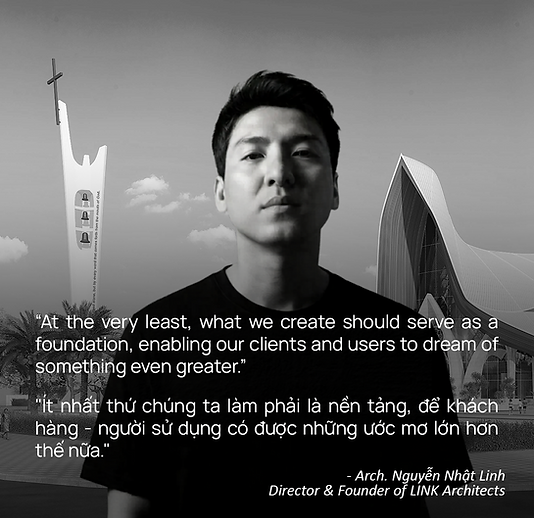
In architectural practice, the boundary between a project that “meets requirements” and one that “truly creates value” can sometimes be remarkably subtle. Many buildings fulfill technical, functional, and budgetary requirements, yet lack a deeper impact on users and society. From the perspective of Nguyen Nhat Linh, architecture only becomes truly meaningful when it goes beyond simply completing a task and instead becomes a foundation for greater values that people can continue to create.

The Architect’s Guiding Role in Creating Value
To distinguish a project that “meets requirements” from one that “truly creates value,” Architect Nguyen Nhat Linh believes the key factor lies not in the scale, form, or complexity of a building, but in the professional ambition of the architect undertaking the project. Setting aside other supporting factors, the way practitioners frame questions and define their role within each project ultimately determines the depth of value a building can bring to its users and society.
In practice, there is no shortage of projects that are executed smoothly and fully satisfy functional, technical, and budgetary requirements. However, if architecture stops at simply completing the initial list of requirements, it can easily become a short-term solution. From this perspective, the true value of architecture does not lie in how “correct” a building is, but in whether it creates something better for people's lives.
Throughout their work, he and his colleagues at LINK Architects share a consistent belief: at the very least, what architects create should serve as a foundation. It should be a foundation upon which clients and users can envision, nurture, and develop greater dreams within the spaces to which they are connected over the long term. Architecture, therefore, is not the endpoint of a problem to be solved, but the starting point for new possibilities.
The concept of a “foundation” here is not limited to its physical or structural meaning. It also refers to the way a space is organized to support everyday life-from living and working to resting and connecting with others. A building can become a foundation for positive change when it allows people to use it flexibly, feel comfortable, and develop a lasting connection with the space. Conversely, a building that merely does “enough” to meet requirements, without sufficient attention to the lived experience, is unlikely to generate sustainable value.
From this perspective, the architect's guiding role in working with clients becomes particularly important. Designers should not simply receive requirements; they need the courage to open up new possibilities, make proposals, and sometimes challenge the initial limitations of a brief. Temporary satisfaction should not be the ultimate goal. Instead, architects should aspire to more, ask bigger questions, and explore deeper approaches to each project.
In many cases, clients approach architects without having a clear understanding of what they truly need from a building. Their initial wishes often reflect only part of their actual needs. This is why architects need to act as partners, helping clients recognize possibilities they may not have previously considered. Such guidance should not be imposed, but should emerge through dialogue, an understanding of the client's living context, and the proposal of appropriate solutions.
Only when practitioners dare to move beyond a safe mindset and the mentality of simply “getting the job done” can the true value of a building begin to emerge. This is not value derived from ostentatious forms or superficial distinctiveness, but value accumulated through thoughtful design, responsibility, and a genuine desire to contribute positively to people's lives. When architects maintain this spirit, every project has the potential to go one step further, beyond the boundaries of its initial requirements.

Professional Maturity Begins with Understanding the Client
Looking back on his many years in the profession, Architect Nguyen Nhat Linh identifies his ability to understand clients as the most significant evolution in his professional thinking. This is something that most architects find difficult to develop early in their careers, when experience is limited and their understanding of the profession has yet to deepen. Such understanding does not emerge overnight; rather, it develops gradually through practical experience and working with a diverse range of people and projects.
When first entering the profession, architects tend to focus heavily on demonstrating their expertise, ideas, and personal identity. Over time, however, exposure to real-world projects helps practitioners recognize that architecture does not exist independently, but is always connected to a specific group of users. Every building carries its own expectations, habits, and living context, requiring architects to observe and listen more carefully.
From this perspective, an architectural product must create value for a specific group within society rather than exist as an abstract product. At its core, design and construction remain service-oriented disciplines, in which understanding the client's needs, desires, and living context is central. Once architects recognize this, their approach to projects gradually becomes more practical and human-centered.
From this point of view, design should not exist merely to satisfy the architect's personal ego, nor should it be driven by theatricality or formal academic conventions. A building only becomes truly valuable when it addresses the specific needs of its clients-the people who will ultimately use it-and has the ability to accompany them throughout their everyday lives.
Featured Projects by:
Nguyen Nhat Linh + LINK Architects
Architecture, therefore, needs to “live” alongside its users. It should adapt to daily routines, habits, and changes over time rather than remain fixed within an idealized image established at the outset. By placing the client at the center of the design process, a building not only meets requirements at the moment of completion, but can also retain and generate value throughout its entire lifecycle.
From Architect Nguyen Nhat Linh's perspective, it is precisely this understanding of people that enables architecture to move beyond its role as a physical product. When a building genuinely serves people's lives, architecture becomes a natural part of society, contributing to the creation of meaningful and more sustainable living environments over the long term.
Nguyen Nhat Linh is the Director and Founder of LINK Architects. With more than 12 years of experience in design and construction, he and the LINK Architects team are committed to creating buildings that not only meet functional and technical requirements, but also pursue positive values for people and society through thoughtfully designed living environments.
Company:
LINK Architects
Website:
Explore More Featured Projects by:
Nguyen Nhat Linh + LINK Architects
Cầu Rầm Church