

Adaptive Reuse – A Major Yet Undervalued Opportunity for Vietnamese Architecture
“Instead of demolishing existing buildings and constructing new ones, we should renovate and reuse them.”

While Vietnamese cities continue to expand rapidly, with new land being developed and new construction projects constantly emerging, another development opportunity remains largely overlooked: the renovation and adaptive reuse of existing buildings. According to Dr. Arch. Hoanh Tran, this is not merely an economic or technical solution, but also an important strategy for preserving urban identity and moving toward a more sustainable development model for Vietnamese cities.
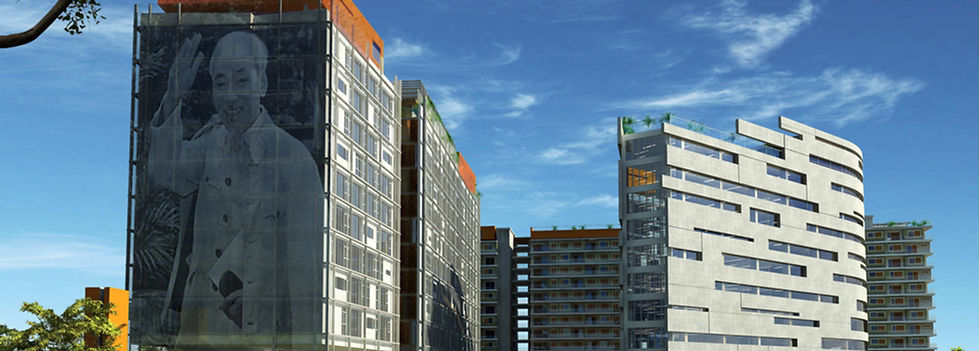
An existing supply that has yet to be activated
In Ho Chi Minh City, Hanoi, and many other major urban areas, an enormous number of buildings have been constructed over the past three decades. Many have deteriorated in appearance or are no longer suitable for their original functions, yet a significant number still have the potential to be reused if properly intervened.
According to Hoanh Tran, rather than assuming that an old building must be demolished, we should first ask whether its existing structure can be upgraded, reorganized, or converted to a new function. Renovation not only helps reduce initial investment costs compared with completely new construction, but also takes advantage of the value of the existing location and surrounding infrastructure.
As demand for housing and commercial space remains high, particularly in central urban areas, renovating existing buildings can create new supply quickly and efficiently. Many people are willing to buy or rent upgraded spaces as long as their quality of use is guaranteed. The issue is that the market and investors still tend to prioritize “building new” as the default solution, while the potential of renovation has yet to be properly recognized as a development strategy.

Cities are layered structures, not surfaces that are constantly replaced
One of Hoanh Tran’s central concerns is urban identity. He views the city as a layered structure accumulated over time. Each historical period leaves behind an architectural layer, and it is precisely this layering that creates spatial depth and urban character.
When old buildings are demolished on a large scale to make way for new, standardized structures, cities gradually lose their memories and diversity. Uniformity in form, materials, and proportions diminishes the sense of time and history. In contrast, some of the world’s most compelling cities are characterized by a combination of old and new architecture, where different eras coexist and engage in dialogue.
Renovation, therefore, is not a conservative act of preserving everything unchanged, but a process of selective intervention. Designers can remove elements that are no longer appropriate, introduce new ones, and restructure spaces so that buildings respond to contemporary needs. The process is similar to re-weaving the urban fabric - where the past is not completely erased, but reinterpreted within a new context.
According to Hoanh Tran, this is how cities can develop without losing themselves. Urban areas should not be recreated like a blank canvas every 20 years, but understood as living organisms with memory and continuity.


Featured Projects by:
Hoành Trần + Hoành Trần Architects (HTA)
Renovation as a long-term environmental and economic strategy
From an environmental perspective, adaptive reuse offers clear benefits. Demolition and new construction consume substantial amounts of energy for material production, transportation, construction, and waste processing. By retaining a building’s primary structure, the amount of new material required can be significantly reduced while construction waste is minimized.
Amid growing climate pressures and increasingly constrained resources, extending the lifespan of existing buildings is an important sustainability strategy. This is not merely a technical issue, but a way of rethinking the entire cycle of urban development: from expansion to optimization, and from consumption to restructuring.
Economically, renovation can also become a new market for the design and construction industries. It requires careful assessment of existing conditions, creativity in converting functions, and close coordination across disciplines. This creates opportunities for architects with flexible thinking and the ability to work with existing conditions rather than designing everything from scratch.
According to Hoanh Tran, Vietnam is at an appropriate moment to seriously consider this direction. Its cities already possess enough “material” to be restructured. What is needed is a shift in perception - among government authorities, investors, and communities - so that adaptive reuse is no longer seen as a secondary option, but becomes a proactive strategy for the future of urban development.
Dr. Arch. Hoanh Tran is a Vietnamese-American architect educated at Columbia Graduate School in New York, the Southern California Institute of Architecture (SCI-Arc) in Los Angeles, and RMIT Melbourne. He founded Hoanh Tran Architects (HTA) in 2004 and has practiced while teaching in Vietnam and internationally for many years. His professional interests focus on adaptive reuse, preservation, and contemporary design within mixed urban contexts. He is currently a visiting lecturer at Vietnamese-German University and Ho Chi Minh City University of Architecture, and regularly contributes architectural and urban design columns and articles.
Company:
Hoành Trần Architects
Website:
Explore More Featured Projects by:
Hoành Trần + Hoành Trần Architects (HTA)
Saigon Airport Plaza
(MEKONG) Delta Blues
X2 Resort Hoi An