

Cà-Phin – The Story of Vietnamese Coffee in Dubai
“Today’s clients are more attentive and patient with the concept and approach, rather than evaluating a project solely based on the ‘perfection’ of its visual renderings.”

Of all the things that designing spaces has brought me, perhaps the most valuable is the opportunity to listen to different stories, meet fascinating people, travel to distant places, and see unfamiliar ways of life through my own eyes.
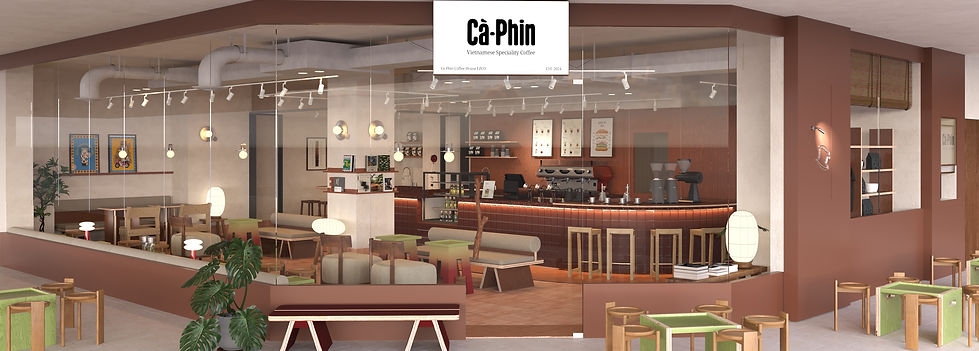
In 2025, I had the opportunity to be part of such a project in Dubai with The Lab team - a Vietnamese coffee shop called Cà-Phin. This article captures some of the impressions that stayed with me after the journey.
Cà-Phin was created with the ambition of introducing Vietnamese Robusta, coffee culture, and the creative spirit of Vietnam’s younger generation to the international community in Dubai. From a design perspective, this raised a familiar question for us: how can Vietnamese culture be brought abroad in a natural and authentic way? This question has become even more relevant as Vietnamese cuisine has gained increasing international visibility in recent years.
When researching existing examples, I noticed a fairly common approach: many brands choose to recreate the Vietnamese setting almost exactly as it is. Familiar elements such as low stools, sidewalk-style coffee seating, stainless-steel tables, weathered walls, and woven bamboo and rattan are reproduced almost identically. But when these objects are removed from the context of everyday life in which they originally belong, the space can easily become a form of “cultural stage” - a place where familiar images serve merely as illustrations of an old memory. This was something we wanted to avoid.
Instead, The Lab approached the space as a small exhibition of contemporary Vietnamese design. The furniture and decorative elements come from studios such as Laita Design, Exutoire, S.Norm, Oho Studio, and Vinadesign - drawing inspiration from familiar Vietnamese life and materials, but reinterpreting them in new ways. Brought together within Cà-Phin, they reveal how Vietnam’s younger generation of designers is engaging with craftsmanship, materials, and its own cultural context.

Another interesting observation I made during the site visit in Dubai concerned the local furniture market. Custom-made furniture is neither as common nor as easy to commission there as it is in Vietnam. The desert climate means that locally available natural timber is limited, while most materials have to be imported, resulting in high production costs. As a result, rather than manufacturing locally, most products are imported from countries with strong manufacturing industries such as China, Vietnam, Malaysia, and Indonesia. This difference highlights, to some extent, the advantages of the domestic market, where there are more favorable conditions for developing and realizing architectural and interior design ideas.


Featured Projects by:
Hùng Lê + The Lab Saigon
Beyond this, the story of Cà-Phin is also expressed through the fixed elements within the space - all of which revolve around coffee, the brand’s core ingredient and central identity.
To deliver the best possible product to customers, Thư Vũ, founder of Cà-Phin, traveled to the Gia Lai highlands to work directly with coffee farms, selecting the beans at their source before they were exported to Dubai. Continuing this spirit, The Lab incorporated coffee into the space in a very direct way:
The door handles are made from coffee tree trunks sourced from the very region where Cà-Phin’s coffee beans are harvested.
The bar façade is assembled from 700 recycled coffee-ground panels, produced in Vietnam by Pando Ecotech, creating a warm, raw material accent at the heart of the space.
The pendant and wall lighting is inspired by the traditional aluminum Vietnamese phin coffee filter, designed by The Lab and fabricated by Cửa Hàng Mài.
From the Vietnamese highlands to a small corner of Jumeirah Lakes Towers in Dubai, Cà-Phin becomes a bridge between origin and a new context, evoking the craftsmanship and sense of community embedded in Vietnamese coffee culture.
For The Lab, this project was also an experiment - a way of responding to a familiar question: how can stories of Vietnamese culture be brought to the world? Personally, I hope that as the industry continues to grow, more Vietnamese stories will be told in different places around the world, carrying a fresh image of a creative Vietnam to international audiences.
Hùng Lê is the Interior Architecture Lead at The Lab Saigon, with more than 10 years of experience in interior design. He graduated with a degree in Interior Design from Van Lang University and currently leads the spatial design team, directly guiding projects from concept development through construction supervision. His practice spans F&B, retail, exhibition, and experience design, with notable projects including De La Sól / Shadow, EVA Exhibition, Yeshi Taiwanese Kitchen, and the Coca-Cola Museum in Long An.
Company:
The Lab Saigon
Website:
Explore More Featured Projects by:
Hùng Lê + The Lab Saigon